Introduction
In the industrial sector, data has always been abundant, but intelligence has been scarce. Factories, oil rigs, and energy plants generate terabytes of data daily from vibration sensors on rotating equipment to video feeds monitoring safety zones. However, for decades, this data has been trapped in silos, locked away in legacy systems, or buried in static paper drawings.
The narrative of the digital transformation manufacturing process is shifting. It is no longer just about digitizing paper records; it is about creating a central nervous system for the enterprise. This shift is being driven by the convergence of Information Technology (IT) and Operational Technology (OT), powered by the newest advancements in Microsoft Fabric.
Through industrial data modernization with Acuvate, enterprises are moving beyond simple dashboards. They are entering an era of autonomous action, where machines don’t just report problems they predict them and, in some cases, fix them.
The Foundation: AcuPrism and Microsoft Fabric
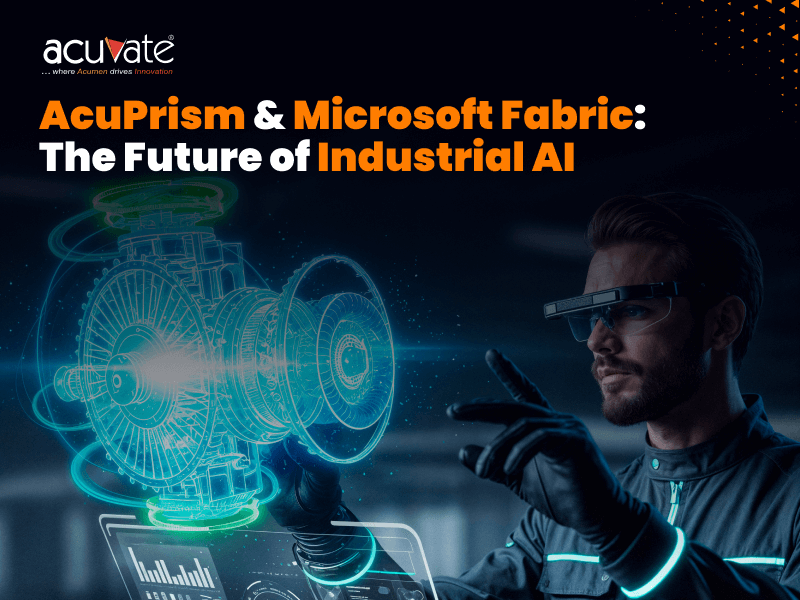
At the heart of this revolution is the AcuPrism Industrial Data Platform. Built directly on top of Microsoft Fabric, AcuPrism is designed to solve the specific, messy, and complex challenges of the manufacturing and energy sectors.
While Microsoft Fabric provides the robust “engine” handling data movement, storage, and analytics AcuPrism provides the “vehicle” tailored for industry. It acts as an accelerator that bridges the gap between raw cloud capabilities and the reality of the factory floor. It integrates seamlessly with existing ERP systems (like SAP) and time-series data historians (like Aveva PI), ensuring that the digital transformation in manufacturing with Acuvate is not a “rip and replace” operation, but a powerful enhancement of existing investments.
This platform approach allows organizations to establish a unified “Ontology” a shared business language. Instead of disparate databases speaking different technical languages, AcuPrism creates a semantic layer where “Pump A” in the maintenance log is automatically understood to be the same “Pump A” in the 3D Digital Twin and the financial asset registry.
Key Aspects Of Digital Transformation In Manufacturing Include:
To truly modernize a manufacturing environment, organizations must look beyond basic data storage. The Acuvate approach highlights three critical pillars that support a modern industrial infrastructure, powered specifically by the AcuNow suite for real-time and edge capabilities.
1. High-Speed Data Streaming and Real-Time Intelligence
The speed of business has increased, but the speed of manufacturing is measured in milliseconds. Real-time manufacturing intelligence is the capability to ingest and analyze data the moment it is created.
Through AcuNow, telemetry data from industrial assets such as temperature, pressure, and vibration is streamed directly into Microsoft Fabric’s Real-Time Intelligence (RTI) module. This is not about looking at what happened yesterday; it is about knowing exactly what is happening right now.
Key capabilities include:
- Massive Velocity: Utilizing event streams and KQL databases to handle high-volume data ingestion.
- Anomaly Detection: Instantly flagging anomalies, such as a sudden temperature spike in a boiler.
- Proactive Alerting: Triggering immediate alerts before a catastrophic failure occurs.


2. The Power of Edge Computing
Not all data can or should go to the cloud immediately. In remote oil fields or high-security manufacturing floors, internet connectivity can be intermittent, and latency is a safety risk. This is where Edge Computing Manufacturing becomes essential.
AcuNow leverages “IoT Operations” to bring the power of the cloud down to the local hardware (the “Edge”). This allows for immediate data processing on-site.
Benefits of the Edge approach:
- High-Bandwidth Processing: Video feeds used for safety monitoring are processed locally to detect hazards instantly.
- Bandwidth Efficiency: Only the relevant insights (e.g., “Safety Violation Detected”) are sent to the cloud.
- Resilience: Critical safety protocols continue to function even if the internet connection goes down.
3. Digitizing the "Dark Data"
A surprising amount of industrial knowledge is still locked in “dark data”—specifically, PDFs and technical drawings like Piping and Instrumentation Diagrams (P&IDs). Acuvate’s DiagramIQ accelerator uses AI to unlock this information.
By scanning these documents, DiagramIQ:
- Extracts specific tag IDs (like valve numbers).
- Connects them to the live digital network.
- Empowers an engineer to search for a valve and instantly see its location on a drawing, its current maintenance status, and its live operational data.
The Next Leap: Agentic AI Autonomous Decision Making
Perhaps the most groundbreaking development discussed is the shift from “Passive AI” to “Agentic AI.”
Traditional AI is passive; it tells you something is wrong (e.g., “The motor is hot”). Agentic AI Autonomous Decision Making takes this a step further by acting as an intelligent coworker. These AI agents are capable of reasoning, planning, and executing tasks using a multi-agent approach (Orchestrator and Child Agents).
Consider the scenario presented in the Acuvate demo where a pump begins to overheat:
- Detection: The Real-time manufacturing intelligence system (AcuNow) detects the temperature spike.
- Analysis: The AI Agent analyzes the data and determines the root cause is likely environmental load.
- Action: The Agent autonomously triggers a command to switch on the auxiliary cooling fan.
- Verification: The Agent monitors the temperature. If it stabilizes, the job is done.
- Escalation: If the temperature continues to rise, the Agent checks the shift schedule, identifies the available maintenance engineer, and autonomously generates a Work Order in SAP, assigning it to the right human expert.
This loop—detect, act, verify, escalate—happens in seconds, vastly outperforming human reaction times for routine issues.
Visualizing the Truth: Digital Twins
Data tables are useful for analysts, but operational leaders need context. This is delivered through Digital Twins 3D virtual replicas of physical assets.
By integrating the AcuPrism Industrial Data Platform with technologies like Kognitwin, companies can visualize their entire facility on a screen. This is not just a static 3D model; it is a live interface.
With this technology, operators can:
- Click on a specific pipe in the 3D model to see the liquid flow rate in real-time.
- Perform remote inspections, reducing the need for dangerous site visits.
- Access a unified view that serves as a cornerstone of modern Industrial data modernization with Acuvate.
Key Benefits & Examples:
The implementation of these technologies results in tangible business outcomes. By moving to a data-driven model, manufacturers are seeing improvements in three primary areas.
1. Equipment Downtime Reduction and Predictive Maintenance
The most immediate financial impact comes from keeping machines running. Unplanned downtime costs industrial manufacturers billions annually. Through Industrial Predictive maintenance solutions, the platform doesn’t just stick to a rigid maintenance schedule; it listens to the machine.
Benefits include:
- Early Detection: Identifying subtle signs of wear (e.g., vibration changes) before a break occurs.
- Proactive Strategy: Shifting from reactive panic to planned maintenance.
- Asset Longevity: Significant Equipment Downtime Reduction, extending the lifespan of expensive capital assets.
2. Enhanced Worker Safety via Computer Vision
Digital transformation also saves lives. By utilizing Edge Computing Manufacturingcapabilities, cameras placed around the facility serve as “always-on” safety supervisors.
The system improves safety by:
- Geofencing: Detecting if a worker has entered a hazardous zone.
- PPE Compliance: Identifying workers without hard hats or high-visibility vests.
- Instant Alerting: Providing audio-visual alerts to the worker and logging incidents for management review.
3. Operational Efficiency through Data Unification
The ultimate benefit is the removal of friction. When an engineer needs to fix a problem, they no longer need to log into five different systems (one for work orders, one for drawings, one for live data). The Digital transformation in manufacturing with Acuvate unifies these views.
Whether utilizing the Real-Time Manufacturing Intelligence dashboard or interacting with an AI Copilot to ask natural language questions like “Show me all pumps with efficiency below 80%,” the friction between the user and the data is removed. This accelerates decision-making and frees up human talent to focus on complex problem-solving rather than data gathering.
Conclusion
The journey of digital transformation manufacturing process is evolving rapidly. We are moving past the age of simple digitization and into the age of Industrial Intelligence.
With tools like Microsoft Fabric, AcuNow for real-time edge processing, and AcuPrism as the central enterprise platform, manufacturers are finally able to harness the full potential of their data. From the autonomous remediation capabilities of Agentic AI Autonomous Decision Making to the life-saving potential of computer vision, the factory of the future is efficient, safe, and self-correcting.
For leaders looking to future-proof their operations, the path forward involves deep Industrial data modernization with Acuvate, ensuring that their enterprise is ready not just for the challenges of today, but for the autonomous innovations of tomorrow.
Industrial Intelligence & Microsoft Fabric - FAQs
AcuPrism acts as a specialized industrial accelerator that sits directly on top of the standard Microsoft Fabric platform. While Fabric provides the core data engine (OneLake, Synapse), AcuPrism bridges the gap between raw cloud capabilities and industrial needs by providing:
- Industrial Connectors: Pre-built adaptors for complex OT sources like SAP ERP, Aveva PI (Time-series), and legacy 5G IoT sensors.
- Unified Ontology: It converts raw technical data (IT/OT/ET) into a “Gold” standard using business logic, ensuring different departments speak the same data language.
- Ready-to-Deploy Solutions: Unlike a blank Fabric instance, AcuPrism comes with industry-specific applications for Predictive Maintenance, OEE, and Production Optimization pre-installed.
This is handled through the AcuNow suite, which is effectively the “nervous system” for real-time data. AcuNow enables the ingestion of high-frequency time-series data from legacy historians (like OSIsoft/Aveva PI) directly into Microsoft Fabric’s Real-Time Intelligence (RTI) module.
- Mechanism: It streams specific tags to Azure Event Hubs or Kafka, bypassing slow batch processes.
- Latency Management: For global operations (e.g., Shell), it supports a regional architecture where data is processed locally before being unified in the cloud, ensuring near real-time dashboard performance.
- Bi-Directional: It allows for “writeback,” meaning AI insights generated in Fabric can be sent back to the operational system to adjust setpoints.
Agentic AI moves beyond the “passive” Q&A of standard Generative AI. It creates an autonomous workforce capable of executing tasks. In the Acuvate model, this functions through a “Parent-Child” agent architecture:
- Detection & Delegation: A “Parent Agent” detects an anomaly (e.g., a pump temperature spike) via AcuNow and delegates the problem to a specialized “Child Agent.”
- Autonomous Remediation: The agent doesn’t just send an alert; it attempts to fix the issue (e.g., turning on an auxiliary fan).
- Orchestration: If self-healing fails, the agent autonomously checks staff schedules, generates a Work Order in SAP, and dispatches it to the correct engineer—shifting the human role from “in-the-loop” (doing the work) to “on-the-loop” (supervising the AI).
DiagramIQ is a specific accelerator designed to digitize the 80% of industrial data locked in static files, such as PDFs of Piping and Instrumentation Diagrams (P&IDs).
- AI Extraction: It uses Azure AI Document Intelligence to scan thousands of drawings, extracting unique Tag IDs (valve numbers, pump IDs).
- Knowledge Graph: It maps these tags into a dynamic Knowledge Graph, creating a live registry that links static drawings to live operational data.
- Benefit: This allows engineers to use a Copilot to ask natural questions like “Show me the maintenance history for the valve in Drawing X,” reducing the time spent searching for information by up to 30%.
An Ontology (part of the Fabric-IQ framework) serves as the semantic bridge that translates code into business concepts. It is essential for creating a functional Digital Twin.
- Business-Centricity: Instead of querying abstract database tables, the Ontology maps data to real-world entities like “Factory,” “Production Line,” or “Customer.”
- Decision Capture: Unlike standard read-only data models, the Ontology supports “writeback.” This means when an operator makes a decision based on data, that decision is captured and fed back into the system, allowing the Digital Twin to learn and evolve based on human actions.